"Scam Likely," "Spam Risk" and "Potential Spam" are warnings your carrier adds to caller ID when its network thinks a call is unwanted. Scam Likely is T-Mobile's label, Spam Risk is AT&T's, and Potential Spam is mostly Verizon's. Don't answer these calls: a real caller will leave a voicemail. Below is what each label means, why your doctor's office can get flagged too, and how to stop these calls from ringing at all.
Short answer: The label is a warning, not a block. Your phone still rings. To stop labeled and unlabeled spam before it rings, you need a call blocker.
Which carrier shows which label
Each carrier scores incoming calls inside its network and adds its own wording:
- T-Mobile and Metro: Scam Likely is the main warning; you may also see Potential Spam or Nuisance Likely for lower-risk calls (T-Mobile).
- AT&T: Spam Risk for nuisance calls and Fraud Risk for calls that look like fraud.
- Verizon: Potential Spam for unwanted calls, Potential Fraud for likely impersonation, and Robo Caller for automated calls.
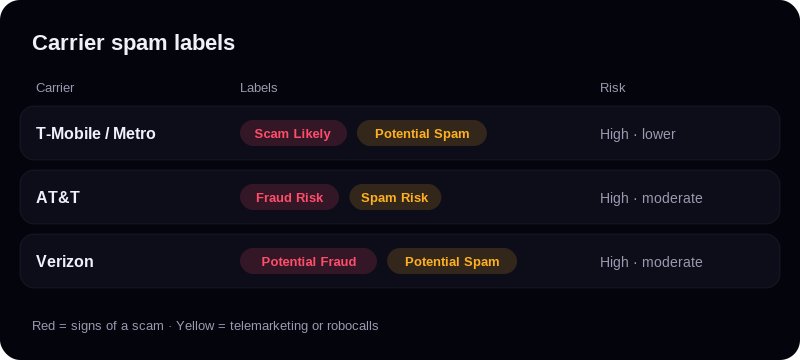
Labels with "Fraud" or "Scam" mean the carrier sees signs of a scam. "Spam," "Nuisance" and "Robo" usually mean telemarketing or robocalls. Neither is proof: it's an automated guess based on how the number behaves.
Should you answer a Scam Likely call?
No. Let it go to voicemail. If it's your pharmacy or a delivery driver, they'll leave a message or text you. The FTC also warns that caller ID can be faked, so even a familiar name on the screen isn't proof (FTC).
If you picked up by accident, hang up, don't press any numbers, and never share a code or payment details.
Why real callers get flagged too
Carriers judge how a number calls, not who is calling. A clinic sending hundreds of appointment reminders, a delivery service, or a school calling every parent can look like a robocaller. Numbers that many people block or report also get flagged. So a label on a call you expected doesn't always mean a scam. Check the voicemail.
Why the label isn't enough
- The phone still rings. A warning interrupts you just like the call itself.
- New and faked numbers slip through. Scammers rotate numbers and fake local ones, so many spam calls arrive with no label at all. Read how this works in What Is Neighbor Spoofing.
- It depends on your carrier. The same number can be labeled on one network and look clean on another.
Stop these calls with Stop Spam
Stop Spam checks every incoming call against our own database of more than 8 million spam numbers and blocks known spammers before your phone rings, whatever your carrier.

Free on the App Store and Google Play. On iPhone, Premium is free for the first 3 days.
Settings → Apps → Phone → Call Blocking & Identification → enable Stop Spam. iOS then either blocks a spam call silently or shows Stop Spam's text label under the number. You also get VoIP spam protection and prefix blocking (for example 425 678 XXXX).
Stop Spam marks calls as Known spammer or Suspected spam and can block all calls except your contacts, plus hidden and international numbers.
Tap Report on a spam call. Every report makes the database better for everyone.
What if your own number is labeled?
If people tell you your calls show up as "Spam Risk" or "Scam Likely," contact your carrier and ask how to dispute the label. Calling fewer people in short bursts and answering callbacks also helps.
FAQ
Does "Scam Likely" mean the caller is definitely a scammer?
No. It's an automated warning based on calling patterns and reports. Most of these calls are spam, but legitimate businesses get flagged sometimes.
What's the difference between Scam Likely and Potential Spam?
Scam Likely is T-Mobile's strongest warning. Potential Spam is a softer label used by Verizon and sometimes T-Mobile for unwanted sales calls and robocalls.
Why do some spam calls have no label?
Carriers can only flag numbers they've seen behave badly. Fresh and spoofed numbers often arrive clean.
Can I call back a Spam Risk number to check?
Don't. Calling back confirms your number is active. Look the number up instead, see how to find out who called you.
Does the label stop scam texts?
No. Caller ID labels apply to calls. Treat texts with links or payment requests as suspicious and don't reply.
Will Stop Spam block calls my carrier labels?
Stop Spam blocks numbers in its own spam database and any rules you set, such as prefixes or all non-contacts. It doesn't read your carrier's label, so it also catches spam your carrier misses.