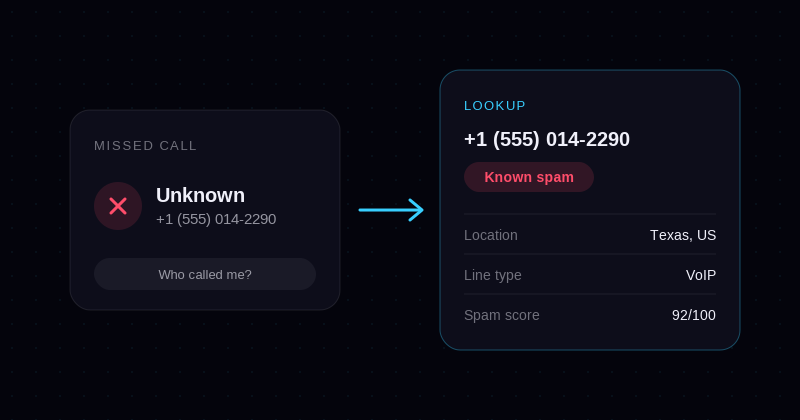
Missed a call from a number you don't recognize? To find out who called you from this number, run it through a phone lookup that checks spam reports, search it on Google, and check the carrier and location. Don't call back until you know who it is. Below are six ways to identify an unknown caller, what each one really shows, and where the "free" lookup sites stop being free.
Short answer: A spam-report lookup tells you fastest whether a number is a scammer. A name is shown only when a database actually has one, and for many mobile numbers no service has it. And caller ID itself can be faked, so the number on your screen may not be the real caller.
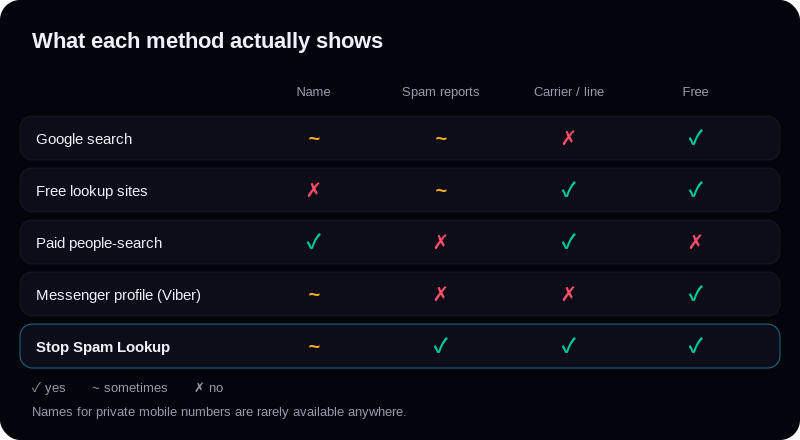
1. Search the number on Google
Type the full number, with the area code, into a search engine. It's free and takes seconds.
- Works well for: businesses, clinics, delivery services, government offices, and anyone who publishes their number online.
- Doesn't work for: private and mobile numbers, which usually aren't indexed anywhere.
- Watch out for: ads at the top of the results that look like lookup results but lead to paid people-search sites.
2. Free reverse phone lookup sites
Sites that promise a "free reverse phone lookup" usually show only the carrier, line type (mobile, landline or VoIP) and the area where the number was issued. The owner's name for a mobile number is typically behind a paywall.
- Community sites, where people leave comments about numbers, are useful only if someone has already reported that number.
- Many of these sites cover US numbers only.
- Security tools like Bitdefender's lookup tell you whether a number is marked as spam, but not who owns it.
3. Paid people-search services
People-search sites build reports from public records, social media and commercial databases. They can show a name and address, but:
- Mobile numbers have no public directory, so the data is often outdated or wrong.
- "Trial" reports for about $1 often turn into a monthly subscription if you don't cancel.
- Under the US Fair Credit Reporting Act, these reports can't be used to screen job applicants or tenants.
4. Check the area code and country code
An unfamiliar country code or an odd number format is a warning sign. But a familiar code proves nothing: scammers routinely fake local numbers. We explain how in What Is Neighbor Spoofing.
5. Wait for a voicemail
A real person, like your doctor's office, a delivery driver or a recruiter, will usually leave a message. Most robocalls won't. If there's no voicemail, there's rarely a reason to chase the number.
6. Look up the number in Stop Spam
Stop Spam's Lookup screen checks a number against our own database of more than 8 million numbers, built from spam reports. Paste the number from a missed call and you'll see:
- A risk label: known spam, suspected, no spam reports, or unknown
- The caller's name, when one is known for that number
- Location, line type and carrier
- Block and Report buttons, so you can stop the number right from the result
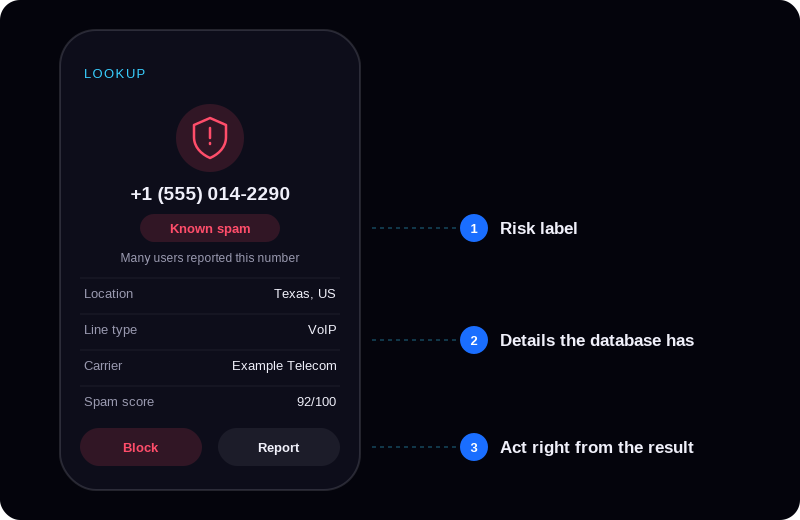
Lookups are free with a short ad. Premium removes ads and limits. We don't promise a name for every number: for a private mobile number nobody has reported, you may see only the carrier and location, but you'll still know it isn't a known spammer.
Should you call back an unknown number?
Not until you've checked it. The FTC warns that caller ID can be faked to show any number, even a real company's. Calling back can confirm your number is active, and if it's a robocall, the FTC advises you to hang up and not press any numbers.
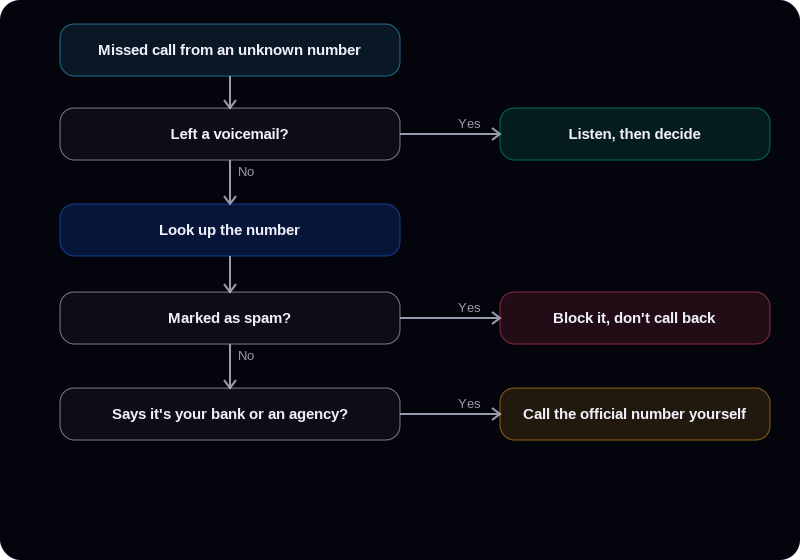
If the call claimed to be from your bank, a government agency or a company you use, don't call the number back at all. Find the official number on your card, a statement or the company's website and call that instead.
Already answered a scam call? Do this
Don't press any numbers and don't argue. You're only confirming that a real person answers this number.
The FTC's rule: never pay someone who calls out of the blue, even if the name on caller ID looks legitimate.
using a number you found yourself, not one the caller gave you.
Report it to the FTC at ReportFraud.ftc.gov, and tap Report in Stop Spam so other users are warned too.
Why this keeps happening
Impostors (people pretending to be a bank, a government agency or a well-known company) have been the most-reported scam in the US for nine years in a row. In 2025 the FTC received more than 1 million impostor reports, with losses of $3.5 billion (FTC, 2026). Many of these scams start with a single unknown call.
FAQ
How can I find out who called me for free?
Search the number on Google, check whether it left a voicemail, and look it up in a spam database such as Stop Spam's Lookup. Free tools rarely show the owner's name for a private mobile number.
Why can't I find a mobile number on Google?
There's no public directory of mobile numbers. Unless the owner posted the number online, search engines have nothing to show.
Are "free reverse phone lookup" sites really free?
Usually only partly. The free part is the carrier, line type and area; the name and address are typically paid, and low-cost trials can renew as subscriptions.
Why do spam calls come from local numbers?
Scammers fake the caller ID to match your area code because people are more likely to answer a local number. This is called neighbor spoofing.
Does the Do Not Call Registry stop scam calls?
No. The FTC notes that the Registry won't stop scammers, who ignore it. It reduces calls from legitimate telemarketers, which makes the scam calls easier to spot.
What's the difference between a lookup and a call blocker?
A lookup tells you about a number after it calls. A call blocker checks numbers as they call and stops known spam before your phone rings. Stop Spam does both. See how to block robocalls on iPhone and Android.